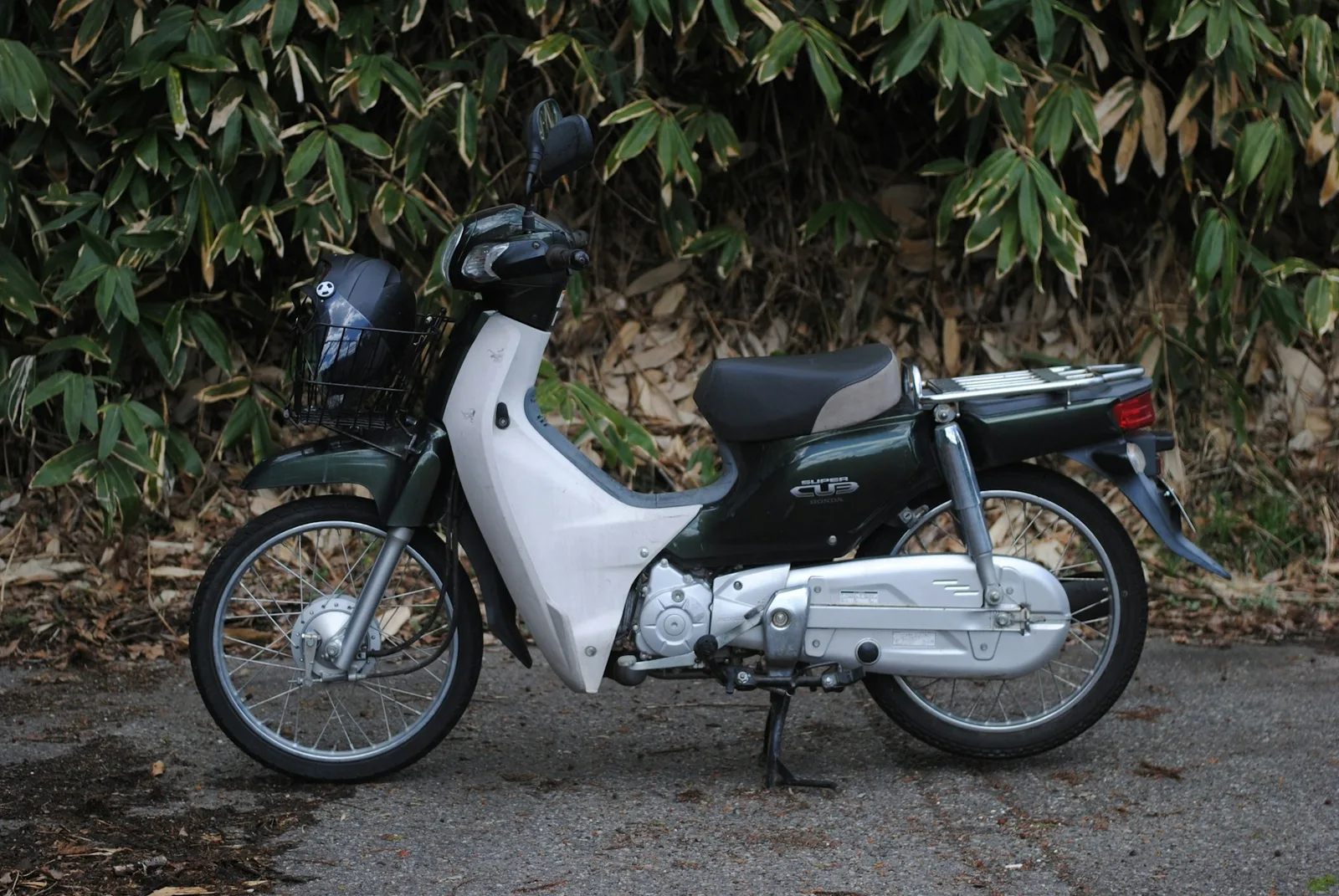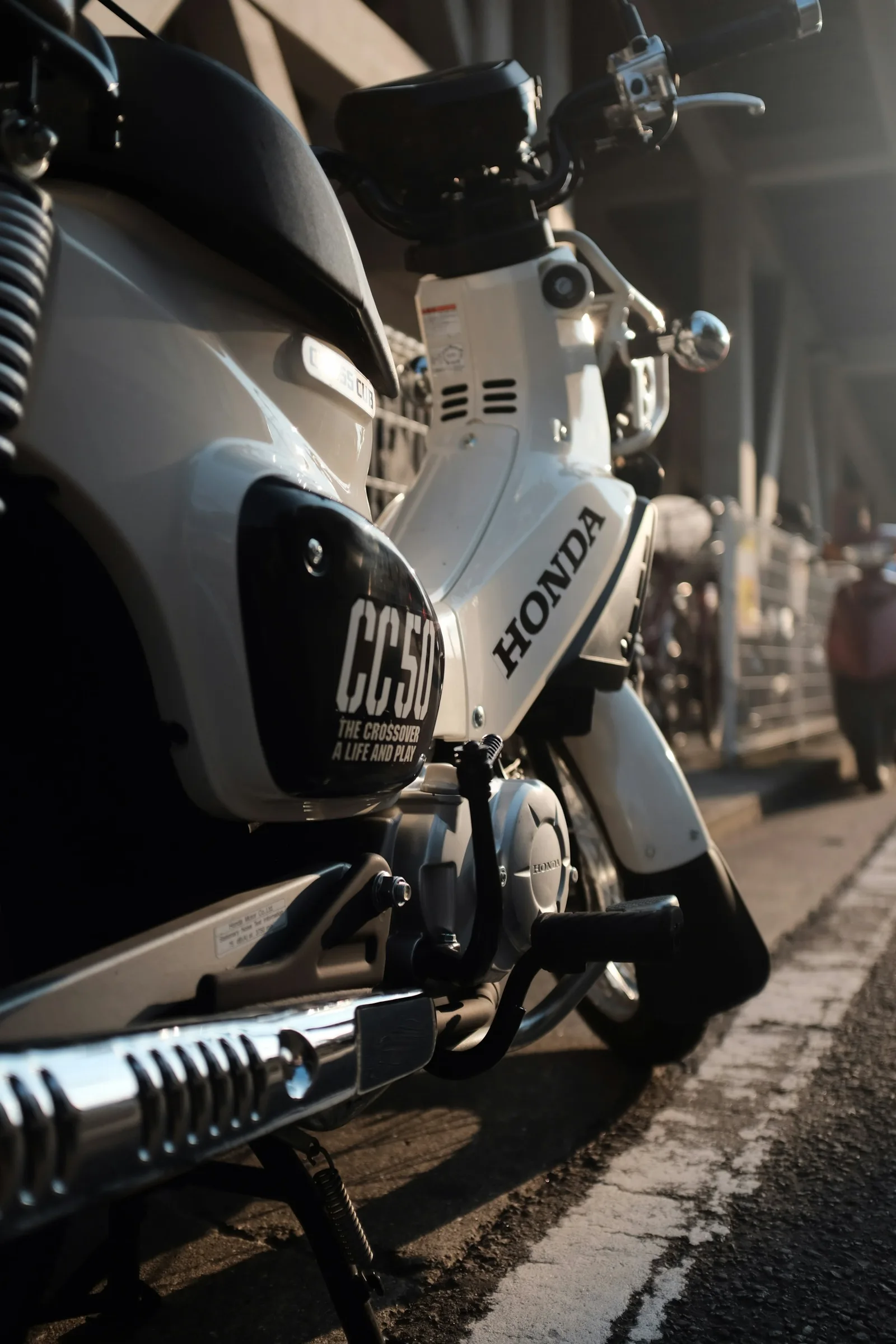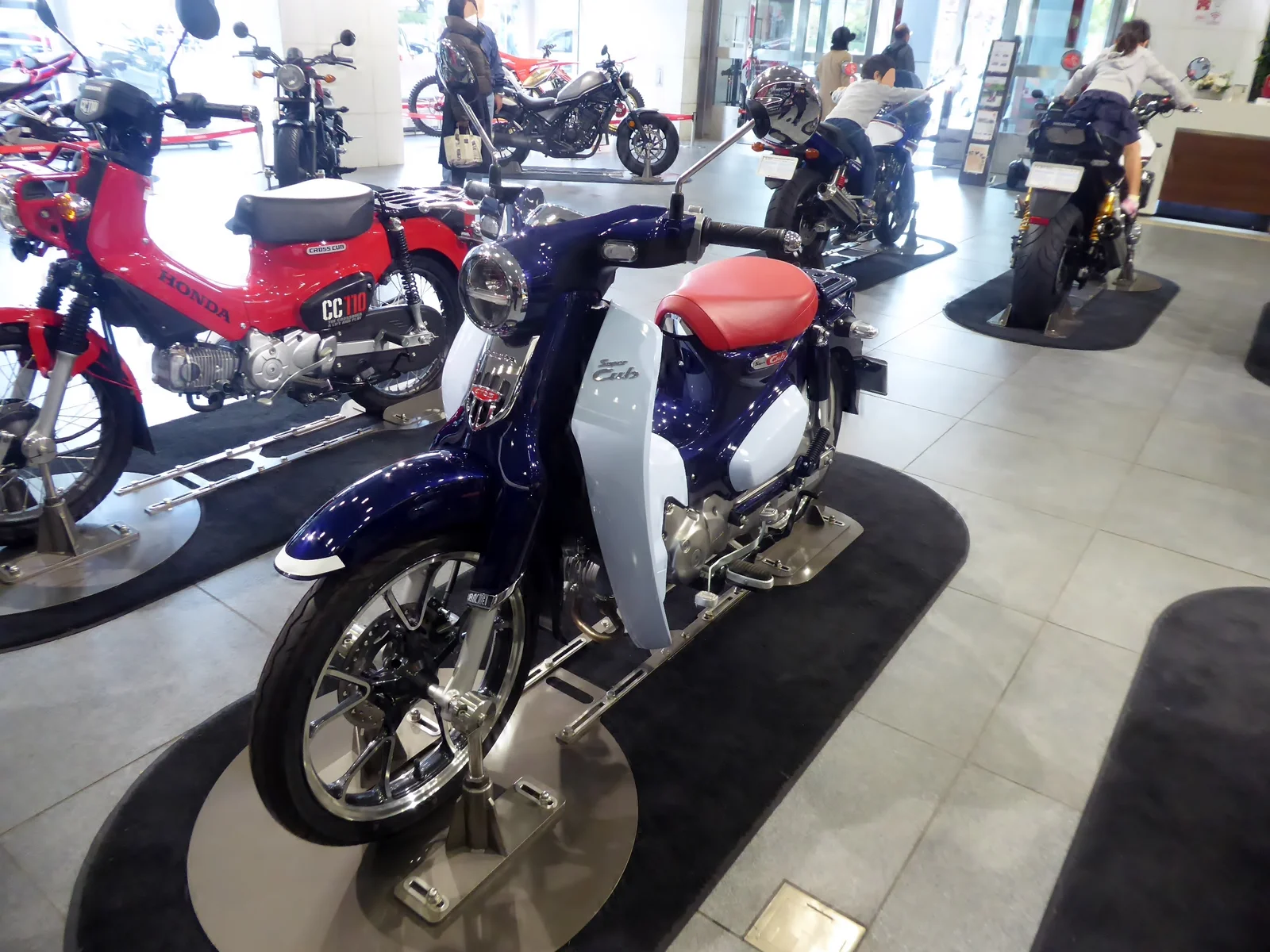
The C90 and C125 share the Super Cub’s step-through idea, but their equipment and ownership details differ. Here we compare Honda’s 2002 Japanese-market C90 Deluxe with the 2019 US Super Cub C125 ABS: a carburetted, three-speed classic alongside a fuel-injected, four-speed modern Cub. These are two documented examples, not specifications for every bike wearing either badge.
Two specific editions, side by side. The photographs and our 3D C90 illustrate the family; they are not identification records for these exact models.
On smaller screens, scroll across to compare both models.
| Detail | 2002 C90 Deluxe · Japan · BC-HA02 | 2019 Super Cub C125 ABS · United States |
|---|---|---|
| Engine | 85 cc, air-cooled OHC four-stroke single | 125 cc, air-cooled SOHC four-stroke single |
| Fuel supply | Carburettor | PGM-FI fuel injection |
| Forward gears | Three | Four |
| Starting | Kick start; the same-year Custom also had electric start | Electric start with Honda SMART Key |
| Brakes | Mechanical drum brakes, front and rear | Front disc with ABS; rear drum without ABS |
| Fuel tank | 4.0 litres | 3.7 litres / 0.98 US gallons |
| Published vehicle weight | 86 kg; Honda lists dry weight separately | 109 kg / 240 lb curb weight |
| Seating capacity | Two people in the Japanese specification | Rider only in the US handbook |
First, put a year and a country beside the badge.
C90 is a name with a long history. Honda’s domestic model archive follows changes to the 90-class engine and bodywork across generations. The badge alone cannot tell you which engine, electrical system or handbook belongs to a particular motorcycle.
For this comparison the classic reference is the C90 Deluxe in Honda’s February 2002 Japanese release. The modern reference is the C125 ABS introduced for the 2019 US model year. That choice lets us attach each detail to a dated source. It does not make a Japanese C90 interchangeable with a British export model, or a 2019 American C125 identical to a later model sold elsewhere.
Engine and fuel: the numbers are only the beginning.
The two examples use air-cooled four-stroke singles. The C90 Deluxe has an 85 cc engine and a carburettor; the C125 has a 125 cc engine with electronic fuel injection. “90” is a model name here, rather than an exact displacement measurement.
For someone researching ownership, the useful next question is how that particular bike has been maintained. A specification table does not tell us the condition of a used machine, how it has been modified or what its previous owner has replaced. This is a comparison of published equipment, not a road test or a prediction of top speed.
Gears: you still choose the ratio.
The C90 example has three forward gears and the US C125 has four. Honda’s Cub clutch design removes the hand-operated clutch lever; “semi-automatic” does not mean the motorcycle chooses the next gear for you. The rider still uses the gear pedal.
Even familiar-looking controls deserve a fresh look at the correct handbook. The 2019 US C125 manual describes its heel-and-toe shifter and shift pattern. Follow the instructions for your edition rather than transferring a remembered pattern from another Cub.
Starting and stopping: look past the silhouette.
The 2002 C90 Deluxe is kick-started, while the Custom in the same Japanese release adds electric starting. An electric starter is therefore not, by itself, proof that a Cub is a modern C125.
The 2019 US C125 combines electric starting with Honda SMART Key. Its front disc has ABS, but its rear drum does not. That distinction matters when an advertisement simply says “ABS”. Honda’s handbook explains the system’s operation and limitations.
The C125 also uses cast wheels and tubeless tyres. Those are useful visual clues when looking at our photograph, alongside the front disc and the lighting. They help explain the modern interpretation; they do not replace the model identification on the actual motorcycle.
Everyday use depends on the particular bike.
Passenger provision is a good example of why the market label matters. Honda lists two occupants for the Japanese C90 in this comparison, while the 2019 US C125 handbook specifies rider-only use. A photograph of a different-market Cub with another seat does not change that instruction.
Think about the journeys you want to make, the storage you need and the support available where you live. For a used bike, gather its identity, maintenance records and any details of modifications before comparing adverts. For a classic, the appeal may include the history of that individual machine; for a C125, it may be the way familiar lines surround newer equipment. Those are personal preferences, not a universal winner.
Choose the manual that belongs to your Cub.
Start with the full model designation, model year and original sales market. Record the frame and engine details too, especially if the bike has been imported or rebuilt. An owner’s handbook explains everyday operation; a workshop manual supplies a different level of service information.
Our handbook guide covers the 2019 US C125A specifically. Use the manual-finding guide below for the next steps with a classic C90 or a different edition. Similar bodywork is a lovely family trait, but it is not enough to select maintenance specifications or replacement parts.
The sources behind the story.
An original Cub Club summary and commentary. Factual references are below; personal interpretations are labelled in the text.
- Honda Japan — Super Cub range update, 12 February 2002
Japanese-language primary specifications for the BC-HA02 C90 Deluxe and Custom. The table uses the Deluxe, with the Custom starting difference stated separately.
Visit original source - American Honda — 2019 Super Cub C125 ABS Features & Benefits
The 2019 US model’s engine, fuel injection, clutch, wheels, tyres and brakes. Published in June 2018; these are period specifications.
Visit original source - Honda — 2019 Super Cub C125A Owner’s Manual
The US 2019 handbook: front-only ABS (printed p. 10), SMART Key (pp. 29–35), starting (p. 47), shifting (p. 49), and capacity, weight and fuel tank specifications (p. 143).
Visit original source - American Honda — C125 return announced, 7 June 2018
The announcement identifies the US introduction as the 2019 model year.
Visit original source - Honda — Japanese Domestic Models, part 1
The changing 90-class family and earlier domestic model variations.
Visit original source - Honda — Super Cub 110 technical factbook, June 2009
Printed p. 6 diagrams the preceding Super Cub 90’s centrifugal clutch. Used only to explain that mechanism, not to substitute 110 specifications for a C90.
Visit original source