Before it was an icon, the Super Cub was a design problem. Make a small motorcycle useful, approachable and capable of coping with the roads people actually used. That everyday ambition is what makes the story so good.
A trip. A question. A new idea.
In 1956, Soichiro Honda and Takeo Fujisawa travelled through Europe looking at small motorcycles. They noticed how differently people used them from country to country. Honda’s account describes a return to Japan with a brief for something that did not fit neatly into the existing moped or scooter categories.
The priorities were practical: an efficient four-stroke engine, easy handling, a friendly shape and gear changes without a hand-operated clutch.
Making it feel simple was the clever bit.
The horizontal engine and low frame opened up room to step through. The automatic centrifugal clutch simplified the controls. Those familiar features were the result of difficult engineering decisions.
Transmission designer Akira Akima recalled the difficulty of making the clutch work with gear changes and the kick starter. A control that disappeared from the rider’s left hand had created a substantial problem on the drawing board. Simplicity had to be built into the mechanism.
The factory had to catch up.
Honda records 24,195 Super Cubs produced in 1958, followed by 167,443 in 1959. Suzuka production began in 1960. The small bike’s success was also a manufacturing story: making an approachable design mattered little unless enough people could actually buy one.
There is an appealing tension here. The object feels intimate, almost domestic. The work behind making it widely available is industrial in every sense. The Cub manages to carry both scales without looking burdened by either.
Hello, Super Cub.
Designer Jozaburo Kimura’s recollection connects the name to the earlier Cub F. Adding “Super” gave the new machine a fresh identity. Honda’s dated production history records the C100’s launch in August 1958.
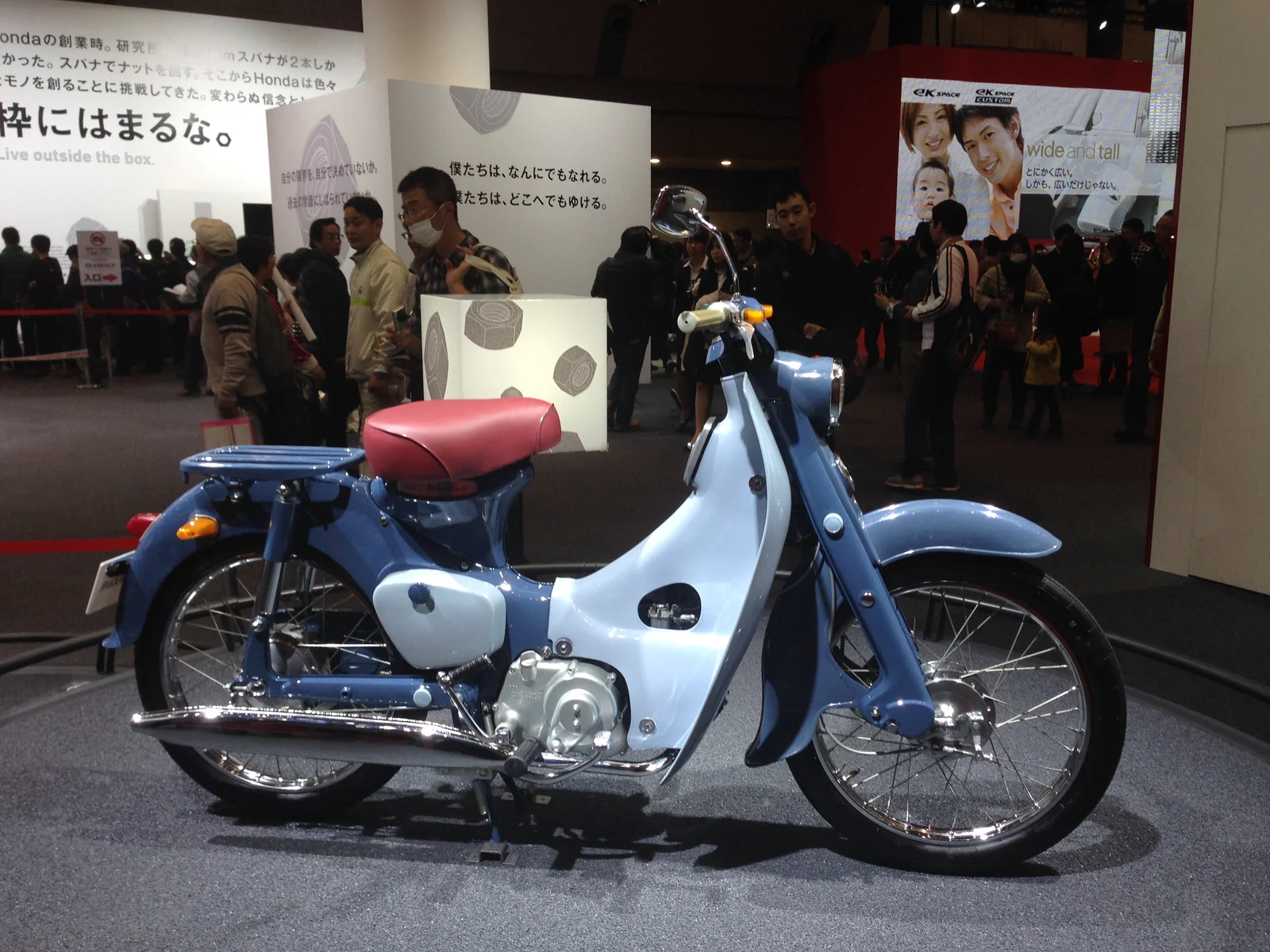
Look at the surviving C100 pictured here: the leg shield, round headlamp and open frame already belong to the visual language we recognise today. The pleasure is in seeing how much character can come from solving a useful problem.
The sources behind the story.
An original Cub Club summary and commentary. Factual references are below; personal interpretations are labelled in the text.
- Honda — The Birth of the Super Cub, part 1
The 1956 trip, original design brief, engine and clutch development.
Visit original source - Honda — The Birth of the Super Cub, part 2
Development recollections, including the tyre challenge.
Visit original source - Honda — The Birth of the Super Cub, part 3
Kimura’s account of choosing the name.
Visit original source - Honda Newsroom — Super Cub production milestone
Dated chronology used to check the August 1958 launch.
Visit original source - Honda Newsroom — 35 million Super Cubs, 2002
The dated year-by-year production table, including the first two years.
Visit original source